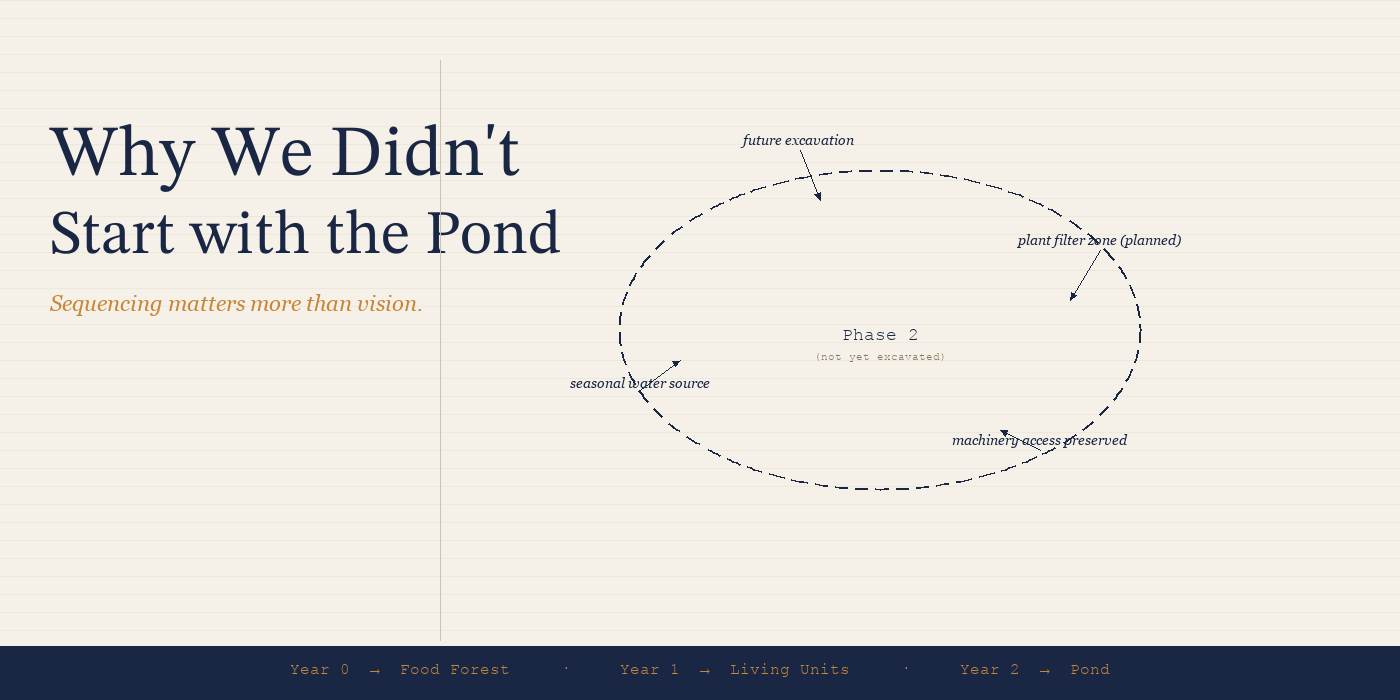
The question comes up in almost every conversation about Lusitano Retreat. Someone reads about the natural swimming pond, or sees a reference to it, and asks when we are building it. The honest answer is: not yet. And the reasoning behind that answer is probably the most useful thing we can share about development sequencing in a project like this.
A biological swim pond is not a feature. It is an ecological system. It requires water, a functioning plant filter, a settled microbiome, and — critically — time. A newly installed pond in its first season looks like a construction site. By season two, it begins to resemble something natural. By season three, if the planting was right and the nutrient load has been managed, it behaves like the thing it is supposed to be: a self-regulating body of water in which swimming is safe, pleasant, and genuinely chemical-free. You cannot accelerate that timeline. Nature does not respond to urgency.
That ecological maturation argument alone is sufficient to push the pond to Phase 2. But the financial argument is equally important and more immediate. A professionally installed biological swim pond at a scale appropriate for a guest retreat — a swimming zone of 40–60 m², properly lined, pumped, and planted — costs €15,000–€30,000 in Portugal. That is real capital. The question is not whether the pond is a good idea. It is whether that capital, deployed in Phase 1, earns a return.
The answer is no. A swim pond does not generate revenue on its own. It requires guests who are paying to use it. Guests who are paying to use it require accommodation. Accommodation requires a Phase 1 investment that comes before the pond in every meaningful sense. Spending €20,000 on a pond before accommodation exists means you have a beautiful ecological feature and no income to maintain it, no guests to use it, and no operational cash flow to fund the next phase of development.
The opportunity cost is concrete. €20,000 in Phase 1, spent on a second accommodation unit rather than a pond, means the difference between one bookable unit generating roughly €12,000–€15,000 per year at 40% occupancy and zero. Over two years, the accommodation unit funds itself. Over three years, it funds the pond. That is the correct sequence.
The sequence we are using is: land, then food forest (planted immediately — trees do not wait for permission), then infrastructure (water, solar, sanitation), then accommodation units, then income, then pond. Each step depends on the prior one being operational. The pond is not an afterthought. It is Stage 5 in a logical build order, and it is Stage 5 precisely because it belongs there.
There is a design discipline that goes with this, however. Not building the pond now does not mean ignoring it. The opposite: it must be designed, sited, and accounted for in every site decision made in Phase 1. Machinery access needs to be preserved. The excavation area must not be built over, compacted by heavy vehicles with no recovery path, or fenced in ways that preclude later access. The pond location should be documented in the site plan with enough specificity that a contractor could mobilise to it in Year 2 without rethinking the entire layout.
We have designated a low-lying area of the site for the pond — well-positioned relative to the food forest and the accommodation terraces, south-facing for maximum sun exposure, at a natural drainage point so winter rain passively tops it up. On paper, in the site plan, the pond exists. On the ground, it is still a field. That is the correct state for a Phase 1 project.
The guest question — what do you say when someone asks about the pond and you don't have one yet? — is easier to answer than it looks. The honest answer, which is also the most effective one, is: we designed it for Year 2 because building it before accommodation would have been the wrong call financially. Guests who are reading enough to ask that question are also reading enough to respect that answer. The pond is not delayed because we couldn't afford it or couldn't be bothered. It is delayed because the sequencing is deliberate. That is a more compelling story than showing someone a pond that was built before there was anything around it.
What guests are actually asking, when they ask about the pond, is whether this is a serious project with an ecological commitment or a rural rental with a marketing angle. The honest answer to that question is not the pond itself. It is the food forest, the chickens, the mushroom logs, the fishing pond, the composting system — all the systems that are already running and producing results by the time they arrive. The swim pond is coming. It will be worth waiting for. The waiting is not a failure of ambition. It is a function of building things in the right order.