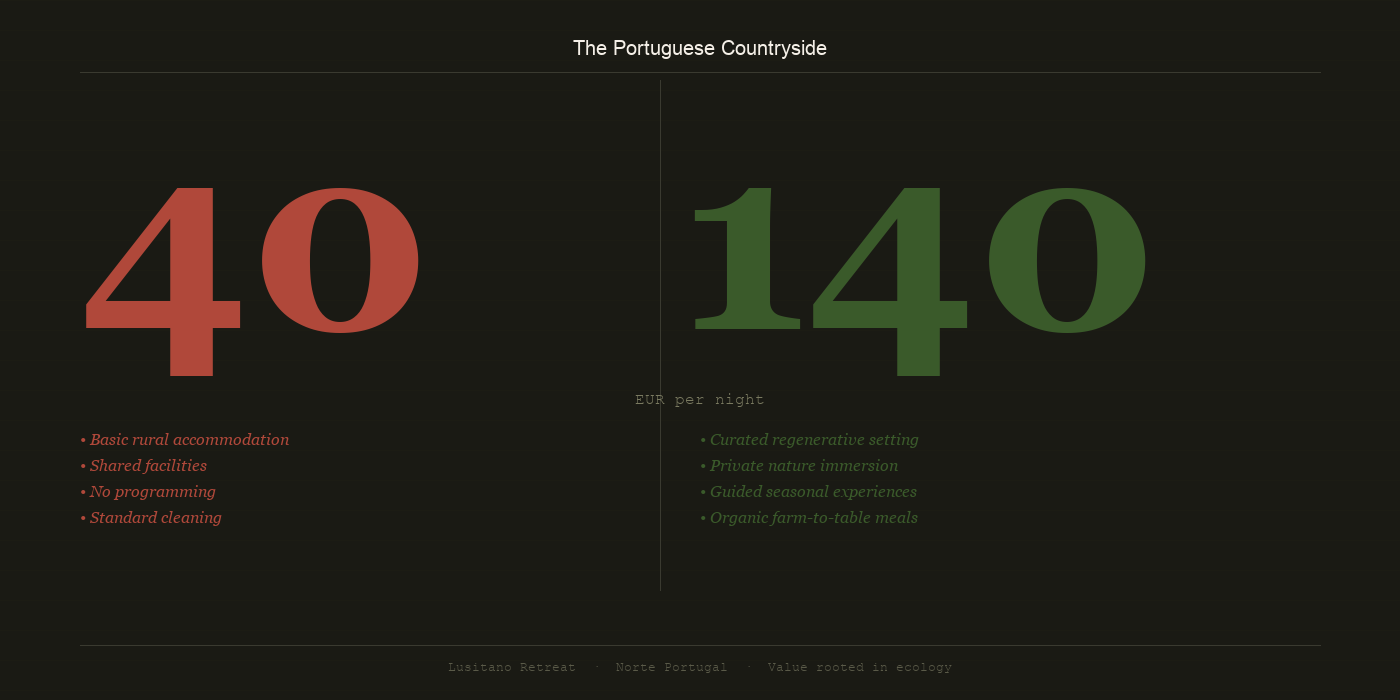
There is a category of rural accommodation in North Portugal that sits around €40–€60 per night on Airbnb. It is usually a stone house, reasonably clean, with a functional kitchen, some wifi, and a view. The host is often a local family who rents it out when they are not using it. The photographs are adequate. The experience is fine. Nothing is wrong with it.
There is another category that sits at €120–€160 per night. The photograph is different. The materials are different. Something about it reads as intentional in a way the first category does not. The guest who pays €140 per night and the guest who pays €40 per night are often looking at properties in the same valley, in the same landscape, with the same rainfall and the same sunsets. The difference in what they are paying for is not the landscape. It is not even primarily the facilities. It is something that requires more careful description.
The most common mistake in rural retreat pricing is charging for what you built rather than what the guest experiences. A host who spends €8,000 renovating a kitchen reasons that the kitchen justifies a higher rate. It usually does not — because guests do not pay a premium for a kitchen. They pay a premium for a feeling. The feeling is produced by the totality of the arrival: what they see when they pull in, what they smell when they open the door, what the first ten minutes feel like before they have unpacked. A renovated kitchen is inside. The feeling starts outside.
What actually separates the €40 property from the €140 property is a cluster of qualities that designers call coherence and materiality. Coherence means the property feels like a complete thought: everything in it belongs together, nothing is accidental, the outdoor furniture matches the interior vocabulary, the colour of the stone matches the colour of the path, the smell of the herbs on the terrace connects to the herb basket on the kitchen counter. Materiality means the surfaces you touch have weight, grain, and age: rough-sawn timber, worn granite, linen that has been washed many times, cast iron rather than aluminium. These things communicate authenticity without language. The guest does not think 'high materiality.' They think 'this is real.'
The permission to do nothing is the premium that guests at a retreat are actually buying. Not activities. Not a scheduled programme. Not even a spa. The psychological permission to stop performing — to sit in a hammock for four hours without producing anything — is extraordinarily difficult to purchase in ordinary life, and genuinely valuable when a property delivers it. It is created by the absence of a schedule, the presence of slow time cues (the fire, the hammock, the view), and the feeling that nothing is expected of you. This cannot be manufactured by a checklist of features. It can be undermined by one wrong choice: a television on the wall, a lock-box that beeps, a welcome card that lists rules.
The minimum viable rate for a two-unit rural retreat to recover its capital investment is easier to calculate than most operators acknowledge. At Phase 1 CAPEX of €87,000–€107,000, with a 15-year depreciation horizon and operating costs of approximately €18,000–€19,000 per year, break-even at 30% occupancy requires an ADR of approximately €130–€160 per night per unit. At €90 per night, break-even requires 45–50% occupancy — achievable but dependent on strong Airbnb presence and consistent review scores. At €140 per night, break-even at 30% occupancy is comfortable, and the operator has room to absorb a slow winter without distress.
Underpricing is more dangerous than overpricing in the retreat market, and for reasons that are not purely financial. A property listed at €55 per night attracts guests whose expectations are calibrated to €55 per night. Those guests will find fault with things that a guest paying €140 would not notice, because the implicit promise at €55 is that everything will be functional, and the implicit promise at €140 is that everything will be considered. A guest who pays €140 and finds a handwritten note, a herb basket, and a fire already laid when they arrive will review at 5 stars. A guest who pays €55 and finds the same things will wonder why the wifi is slow.
The Airbnb dynamic deserves direct treatment. The platform is useful for early-stage launch because it provides discoverability and booking infrastructure that would otherwise cost months and significant development budget to build. But the platform exerts downward pressure on pricing through its visibility tools, which signal to hosts when their price is 'above average' for comparable properties — a metric that pulls every property toward the median. The correct long-term model for a retreat is to use Airbnb for the first 12–18 months to build review volume and then systematically shift direct booking traffic to a lower commission, higher control channel. Direct bookings at €140 per night produce better margin than Airbnb bookings at €130.
The €300 fire pit justifies the premium better than the €8,000 kitchen renovation. This is not a counterintuitive claim — it is a statement about where the guest experience actually lives. The fire pit is the social and emotional centrepiece of the evening. It is where the photographs happen, where the conversation happens, where the sense of warmth (literal and emotional) concentrates. The kitchen is where cooking happens, and in a self-catering retreat, cooking takes an hour. The fire takes four. The fire pit is a low-cost, high-impact investment in the experience that guests are actually paying for. The kitchen renovation is a high-cost, low-impact investment in the experience that guests expect to be functional regardless of what they are paying.
What guests are paying for, at the top of the rural retreat market, is permission plus materiality plus story. The story is what they tell people when they get home: 'we stayed at this place in North Portugal, completely off-grid, the host left fresh figs from the garden, we swam in a natural pond, we sat by the fire every night.' The story is the product. Everything that produces the story — the figs, the pond, the fire, the quiet — is the design challenge. The rate you charge is the signal that tells the right guest whether they are in the right place.