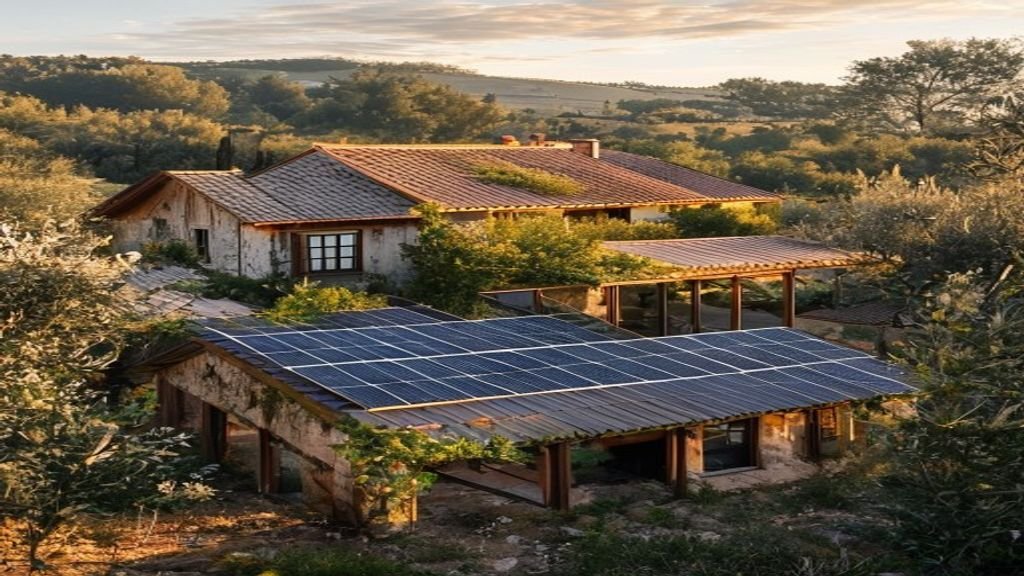
There is a lot of aspirational content online about off-grid solar. Most of it is vague. This is not that. These are the actual specifications of our system, the actual production numbers by month, and the actual lessons from 14 months of operation.
## Why We Went Off-Grid
The short answer: cost. The nearest electricity transformer was 380 metres from our site boundary. The quote from E-REDES (the grid distribution operator in Portugal) for the new connection was €19,400. Our solar and battery system cost €24,800 installed.
The capital cost difference was €5,400 in favour of grid connection. But the off-grid system has zero annual standing charge, doesn't require excavating 380m of service trench through other people's land, and produces energy from a renewable source that we talk about to guests. The additional €5,400 was easily justified.
If the grid connection quote had been €8,000, we would have gone hybrid (grid + solar + battery). Numbers first, principle second.
## The System Specification
**Solar array:** 18 x 380W monocrystalline panels = **6.84kWp**. South-facing at 30° tilt on a ground-mounted frame. Array location chosen for zero shading between 9am–5pm throughout the year.
**Inverter/charger:** Victron MultiPlus-II 48V/5000VA. Industry standard for off-grid systems. Excellent monitoring, widely serviced in Portugal.
**Battery bank:** 4 x Pylontech US3000C LFP batteries = **14.4kWh usable capacity** (at 80% depth of discharge). Rated for 6,000 cycles. Expected lifespan: 15+ years.
**Generator backup:** Honda EU22i 2.2kVA petrol generator. Used an average of 6 hours per week in winter (December–February). Not used at all April–October.
**Monitoring:** Victron VRM portal. I can check the system from my phone at any time. Hourly production and consumption data, battery state of charge, and alarm notifications.
## The Numbers: Monthly Solar Production
| Month | Production (kWh) | Notes | |-------|-----------------|-------| | January | 487 | High cloud cover; generator supplement needed | | February | 612 | Improving significantly | | March | 891 | Excellent production begins | | April | 1,124 | Near-zero generator use | | May | 1,287 | Best month | | June | 1,241 | Highest sun angle; still excellent | | July | 1,318 | Peak production month | | August | 1,289 | Similar to July | | September | 1,043 | Good | | October | 788 | Rapid decline | | November | 542 | Generator starts again | | December | 421 | Worst month |
**Annual total: 11,043 kWh.** Our annual consumption is 9,200 kWh (current use with partial occupancy). When at full 12-guest retreat capacity, we estimate consumption will reach 14,000–16,000 kWh — requiring either generator supplement in winter months or expansion of the array and battery bank.
## What I'd Do Differently
**I'd add 4 more panels from day one.** The marginal cost of adding panels during initial installation is much lower than retrofitting later. Going from 7kWp to 10kWp would cost perhaps €2,000 more at installation; doing it now as a retrofit would cost €4,000–6,000.
**I'd install a hot water diverter immediately.** An immersion heater diverter uses excess solar production (rather than wasting it) to heat a hot water cylinder. We added one in month 6 and it now provides free hot water from March to October. Cost: €180 for the Immersun unit. One of the best value additions to the system.
**I'd be more conservative on battery sizing.** 14.4kWh is sufficient for summer but tight in winter. 25–30kWh would give more comfortable winter operation without generator dependence.
## The Honest Verdict
Off-grid solar in Norte Portugal is viable but requires realistic expectations about winter. The system works excellently for 8 months of the year. The remaining 4 months require either supplementary generation or reduced consumption. For a retreat that naturally sees lower occupancy in winter (as ours does), this matches well.
---
*Full system specification and installer contacts available for projects in Norte. Drop us an email.*