The no-dig method is not a gardening philosophy. It is a practical technique with a specific mechanism and a measurable outcome. Charles Dowding, the British market gardener who has documented the method more rigorously than anyone else over a 40-year growing career, is its most prominent practitioner, but the underlying principle predates him by centuries: soil is a living system, and disturbing it — through digging, rotavating, or ploughing — destroys the fungal networks and microbial communities that determine its productive capacity. The no-dig method leaves that system intact, suppresses weeds by exclusion rather than removal, and builds organic matter on top rather than turning it in. The result is better soil in year three than you would achieve with digging in year ten.
For a rural retreat property in North Portugal, the case for no-dig is reinforced by a practical consideration that has nothing to do with philosophy: time. A solo retreat operator does not have time to rotavate, weed, and re-dig beds every spring. The no-dig system, once established, requires no digging ever again. Weeds do not return through the soil surface because the soil surface is permanently covered. The ongoing maintenance is composting, planting, and harvesting. That is compatible with running a retreat. Digging is not.
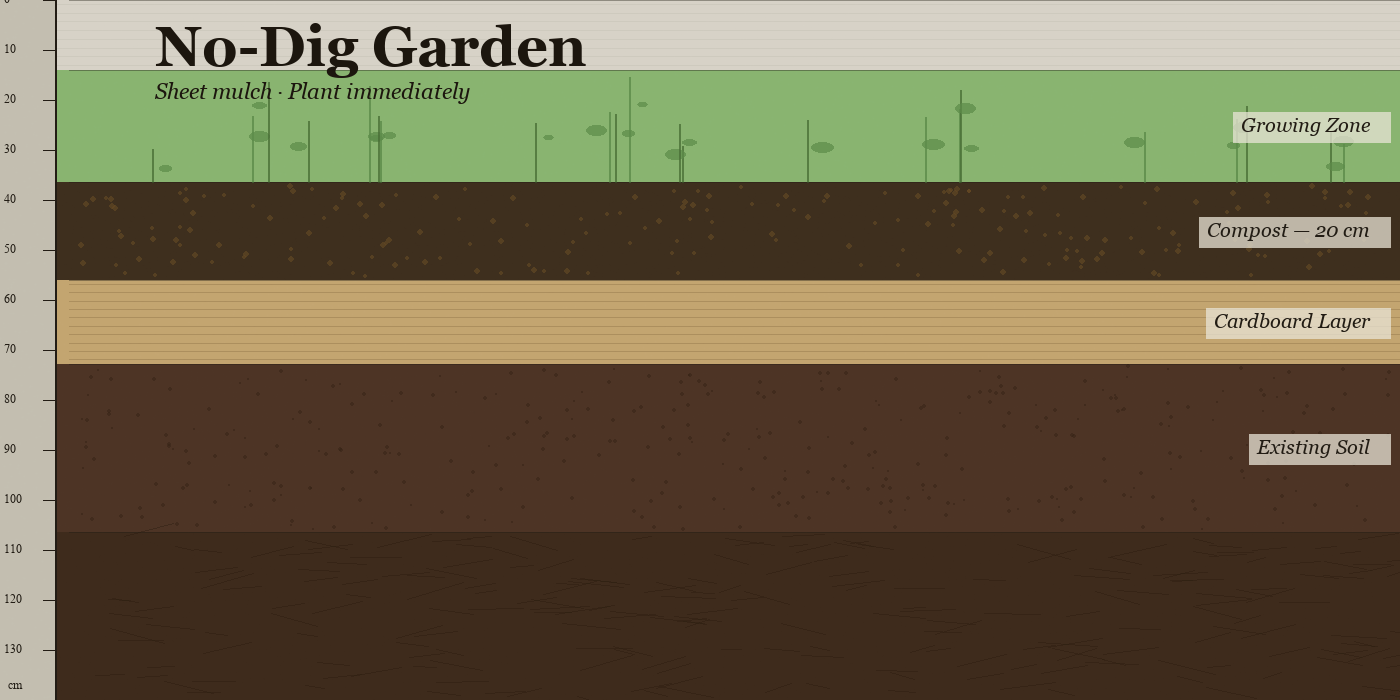
The method is as follows. Lay cardboard directly on the ground — on existing grass, on weeds, on rough pasture. The cardboard must overlap by at least 20 cm at every join to prevent weeds pushing through the gaps. Wet the cardboard thoroughly. On top of it, lay 20 cm of compost. Do not use topsoil. Do not use garden centre multi-purpose compost at €4 a bag. Use bulk-delivered municipal green waste compost or farm compost — sourced from a Portuguese compostagem facility or a local livestock farmer — which costs €15–25 per cubic metre delivered. For 100 m² of bed at 20 cm depth, you need approximately 20 cubic metres of compost. That is €300–500 in materials. The cardboard is free from any retailer, furniture supplier, or supermarket who has packaging waste to dispose of.
The critical point that surprises people who have not tried this: you plant immediately. You do not wait for the cardboard to rot. You do not wait for the grass beneath to die. You put transplants or seeds directly into the 20 cm compost layer on the same day you lay it. The roots of the plants will reach the cardboard layer within a few weeks and then penetrate it as it begins to soften. By the time the roots need to go deeper, the cardboard has started to break down and the grass beneath has been killed by light exclusion. Nothing is waiting. The system is live from day one.
What to grow in the Minho climate, and when, is not a generic permaculture answer — it is a specific question about an Atlantic climate that is wetter and milder than most of continental Europe. The critical advantage is winter production. Kale, chard, spinach, and rocket are productive in North Portugal from October through to April without protection. These are not summer crops being forced through winter with polytunnels. They are the natural winter crops of an Atlantic climate, and they grow in the Minho with very little intervention. This is significant for a retreat because it means guests arriving in November or February can still harvest from the garden. That continuity of experience across seasons has real marketing value.
The summer plan: tomatoes planted out in late May or early June (after the last frost risk, which in the Minho valley is typically late April); courgette and cucumber from mid-May; peppers in June. The Minho summer is warm and receives enough rainfall that irrigation is often unnecessary in June and July. August and September can be dry — this is when the wicking beds matter most. A wicking bed is a raised container with a water reservoir beneath the root zone, connected by a wick. The plant draws moisture upward through capillary action. In a well-made wicking bed, you water once every 10–14 days in summer. This is compatible with a retreat operator who has changeovers, guest management, and sourcing to handle on the same days.
The full year-round cropping plan for 100 m² in the Minho: garlic planted in October (harvest June), kale and chard throughout winter, broad beans from November (harvest April–May), tomatoes and courgette from June (harvest July–September), winter squash from July (harvest October–November), herbs throughout — parsley, coriander, basil in summer, rosemary and sage year-round. This is not a theoretical plan. It is what grows in this climate with minimal intervention. The question is not what you can grow but what you choose to focus on in the available space.
Comfrey (*Symphytum officinale*) is the plant that deserves special mention as a companion to the no-dig beds. Plant it once at the edges of your beds and never move it. Its deep taproot — reaching two metres or more — mines potassium, phosphorus, and trace minerals from subsoil and concentrates them in leaves that can be cut and used as mulch directly on the compost surface. This is free fertiliser that renews itself every four to six weeks throughout the growing season. It does not compete with garden crops because its roots go where crop roots do not reach. It is the cornerstone of low-input fertility management and costs roughly €2 per root cutting.
The year one versus year three yield difference is real and worth stating as a planning expectation. In year one, the beds are productive from the first planting — the 20 cm of fresh compost is highly fertile — but the soil biology beneath the cardboard is still establishing. By year three, the fungal networks have extended throughout the bed, the compost layers from successive top-dressings have built a deep, friable soil, and the weed suppression is essentially complete. The difference in plant health and yield between a year-one and a year-three no-dig bed is visible and significant. Expect 50–70% of mature yield in year one, 80–90% in year two, full yield from year three.
Guest participation is the dimension that justifies a kitchen garden beyond its operational value. Guests at a rural retreat who are given permission to pick their own herbs, harvest a courgette, pull a few kale leaves, or dig garlic are not doing chores — they are engaging in the most straightforward form of connection to a place that exists. This does not require a programme or a workshop. It requires a clearly planted, legible garden with a basket and a simple note explaining what is in season. The experience costs nothing additional once the garden is established, and it generates exactly the kind of mention in reviews that no marketing budget can buy: ‘we picked herbs from the garden for every meal.’
The cost summary: 100 m² of no-dig beds in Norte Portugal costs €200–400 in materials (compost bulk delivered, free cardboard, basic seed stock). Labour is one or two full days, not requiring machinery or specialist skills. The setup can be done in a single weekend by one person. The return is year-round fresh vegetables and herbs for two accommodation units, a guest experience asset, and a soil system that improves every year without digging. There is no equivalent investment-to-return ratio elsewhere in retreat infrastructure.
A final practical note on scale: 100 m² is not a large garden. It is approximately 10 m × 10 m — smaller than most people imagine when they think of a productive kitchen garden. In a Minho climate, 100 m² planted intelligently and managed with wicking beds for summer annuals will produce enough salad, herbs, courgettes, tomatoes, and winter greens to supplement the kitchen meaningfully for two units. It will not replace a market. It is not intended to. It provides the fresh, daily-harvested element that transforms a guest’s relationship to the place — and that is what it is for.