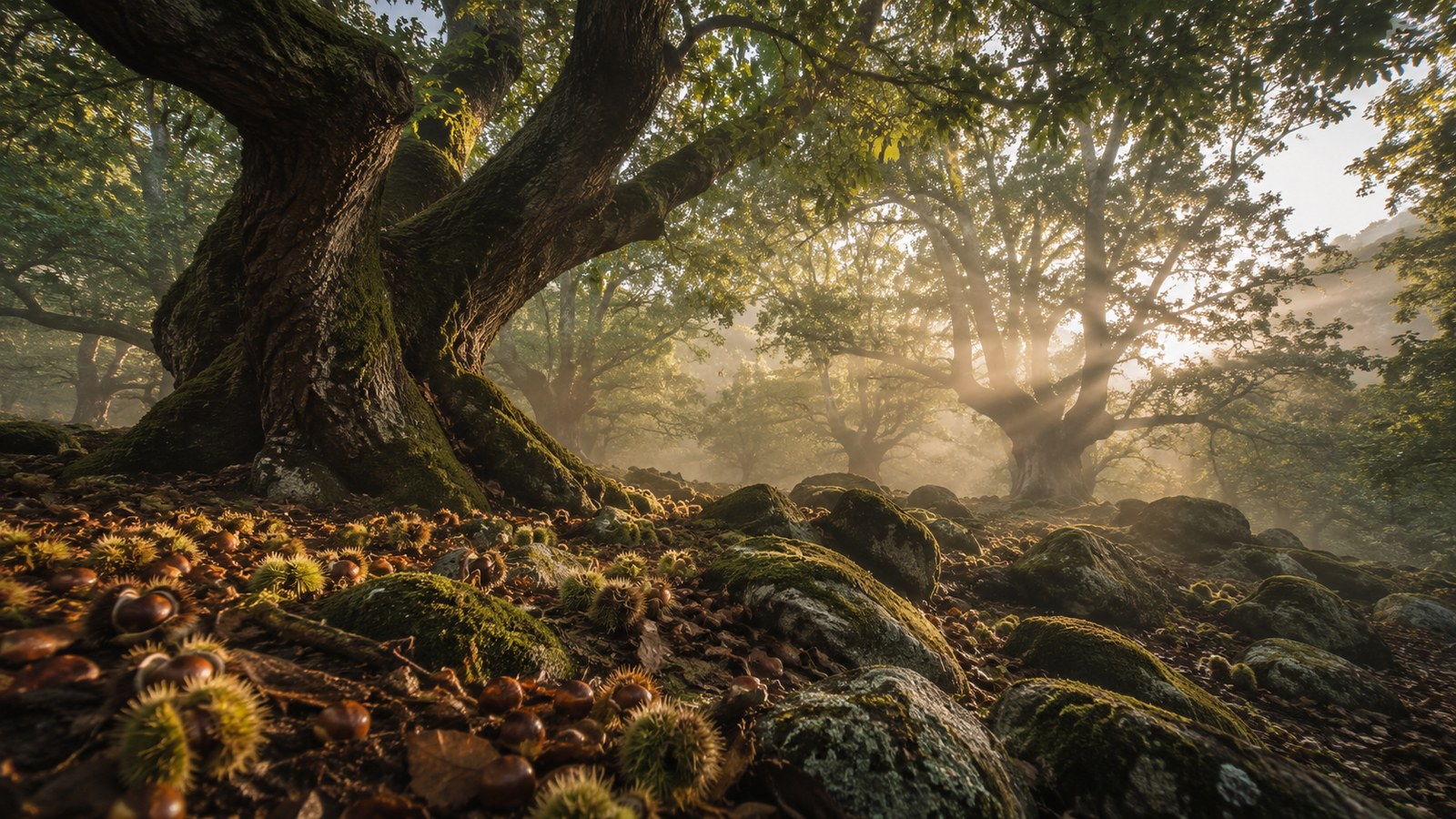
Ask someone what tree defines North Portugal and they'll probably say pine or eucalyptus. Ask someone who has been here for fifty years and they'll say chestnut. There's a reason the old-timers are right.
## What a Souto Actually Is
A *souto* is a managed sweet chestnut grove — a land management tradition that has existed in this part of Portugal for at least 2,000 years. The trees are planted in rows or grids, pruned to allow good light penetration, and harvested every autumn. In Trás-os-Montes, entire villages were economically organised around their soutos. The chestnut was flour, protein, animal feed, timber, tannin, and firewood — essentially a complete small farm in a tree.
The abandonment of soutos across Norte Portugal over the past 40 years — as rural populations urbanised and intensive agriculture replaced traditional land use — is one of the quieter ecological tragedies of modern Portugal.
## The Ecology
Sweet chestnut (Castanea sativa) is one of the most ecologically generous trees in the European temperate zone. A mature souto:
- Produces 20–50kg of nuts per tree per year (edible by humans, wildlife, and livestock) - Supports hundreds of invertebrate species in its bark, deadwood, and canopy - Creates a deep leaf litter layer that builds soil carbon over decades - Fixes the canopy at a height that allows a rich understory to develop - Is drought-tolerant once established (deep root system taps subsoil moisture) - Lives for centuries — some souto trees in Northeast Portugal are over 400 years old
Compared to eucalyptus — which dominates huge areas of Norte Portugal, creating biological deserts and catastrophic fire risk — chestnut is in an entirely different ecological category.
## The Commercial Case
A 0.5-hectare souto planted today at 6x6m spacing (approximately 140 trees) will begin producing meaningful nut harvests in 8–10 years. At maturity (20+ years), annual yield could reach 3–7 tonnes of chestnuts — worth €1,500–5,000 as farm-gate fresh nuts, or significantly more as processed products (farina di castagne, chestnut honey, dried chestnuts, chestnut preserve).
But for an eco retreat, the commercial value of chestnuts is secondary to their experiential value. The harvest season — October to November — is a genuine guest experience. Foraging, roasting, making chestnut soup in a communal kitchen. These are not manufactured activities. They're what people here have done for centuries.
## The Ink Disease Problem
One caveat that must be mentioned: sweet chestnut in Portugal is threatened by Ink Disease (Phytophthora cinnamomi) and Chestnut Blight (Cryphonectria parasitica). These have devastated some historic soutos. The solution is not to avoid planting chestnuts, but to source resistant or tolerant cultivars (Marigoule, Longal, Negral) from certified nurseries, and to avoid planting in waterlogged or poorly drained soils where Phytophthora pressure is highest.
## What We're Doing
We planted 28 chestnut trees in our first autumn. All went in as bare-root whips from a regional nursery using resistant Longal and Marigoule varieties. We're treating this as a long-term investment — not in chestnuts, but in landscape, habitat, culture, and story.
In 10 years, these trees will be part of what makes this place what it is.
---
*The first chestnut harvest will be open to retreat guests. Bookmark this for autumn 2033.*