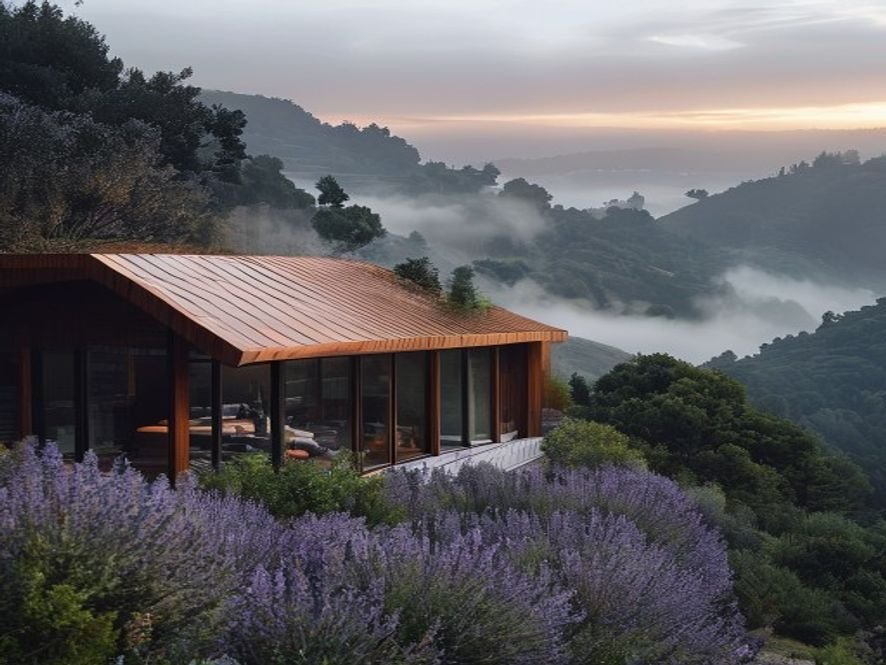
Walk through any village in the Minho or Trás-os-Montes and you'll see the same construction palette repeated without variation for five centuries: granite walls, schist infill, chestnut or oak timber beams, and roofs of slate or handmade clay tile. Not because these people lacked imagination. Because these materials work here. They handle the climate — wet Atlantic winters, dry continental summers — with an intelligence that no imported material has matched.
When we started building at Lusitano Retreat, the easiest path would have been standard Portuguese block construction: hollow terracotta blocks, cement render, aluminium frames. Fast, cheap, available from any hardware merchant within 20 minutes. We didn't take that path. This article explains why, and what the alternative actually involves.
## The Vernacular Palette and Why It Works
Granite is the foundation of Norte. The geology makes it unavoidable — you'll hit it 300mm down almost anywhere in the Minho. Granite walls are dense (around 2,700 kg/m³), which means they act as thermal mass: slow to heat, slow to cool, keeping interiors naturally regulated without mechanical assistance. A 600mm granite wall maintains a roughly 5–8°C differential between inside and outside temperature at the extremes of both summer and winter.
Schist — the darker, layered stone common in Trás-os-Montes and parts of the Douro valley — is used differently. Its natural cleavage makes it ideal for infill panels, garden walls, and dry-stone retaining structures. It splits cleanly and stacks tightly without mortar.
Timber was historically chestnut (*Castanea sativa*) for structural beams and floors, and oak (*Quercus robur* or *Quercus pyrenaica*) for heavier framing. Chestnut is naturally resistant to fungal decay — its tannin content makes it one of the few European timbers that performs without chemical treatment outdoors. A well-maintained chestnut beam in a Norte farmhouse is routinely 150 to 200 years old and structurally sound.
Slate for roofing acts as an almost zero-maintenance cladding in a high-rainfall climate. Clay tiles (telha de canudo, the half-round Portuguese type) are slightly less durable but thermally better and visually warmer. Most older buildings in the north use both, depending on the roof orientation and period of construction.
## Where to Source Reclaimed Material
The supply chain for reclaimed stone and timber is informal, fragmented, and occasionally infuriating. Here's where it actually is:
**Demolidoras** (demolition contractors) are the primary source of reclaimed granite and schist. Firms operating in the north — particularly around Braga, Guimarães, and Viana do Castelo — regularly clear old buildings and stockpile the stone. Prices for sorted, palletised granite blocks run roughly €45–80 per tonne depending on size and condition. Ungraded mixed stone direct from a demolition site can be as low as €20/tonne, but sorting time is significant.
**OLX.pt** is the Portuguese classifieds platform and genuinely useful. Search "granito" or "pedra granito" with a regional filter and you'll find individual farmers selling stone from old walls or building clearances. We sourced 6 tonnes of dressed granite lintels this way at €12 per lintel — material that would have cost €90+ per unit new from a stone yard.
**Directly from villages.** Several quintas in our valley have outbuildings that collapsed decades ago. Owners are often willing to let stone be removed in exchange for the clearance labour. This requires patience, goodwill, and a willingness to spend three weekends moving rubble in exchange for free material. We've done this twice. It is exactly as physical as it sounds and exactly as worth it.
## The Stonemason Problem
The more urgent issue is not the material — it's the labour. Traditional stonemasons who can build or restore a granite wall to a proper standard are genuinely rare in Norte Portugal and getting rarer. The generation of *pedreiros* who learned the craft as apprentices in the 1960s and 70s are now in their 70s and 80s. Their successors are far fewer.
The practical implication: if you want a stonemason for a significant project, you should expect to book 6 to 12 months ahead. We waited eight months for ours. He came with his son (who does know the work) and a nephew (who is learning). They are booked through the end of next year.
Do not assume this is a problem you can solve with money alone. Availability is the constraint, not price.
## The Economics
Local granite construction costs more per square metre than block construction — typically 30–50% more in direct material and labour costs. We haven't tried to pretend otherwise.
What we'd argue is that the comparison is incomplete. A granite wall built well requires no render, no periodic repainting, and no remedial work for 50+ years. It doesn't need vapour barriers or cavity insulation to meet thermal performance requirements in a Norte climate. It doesn't look like every other building on the road.
For a retreat whose commercial value depends partly on a sense of place, authenticity, and rootedness in the landscape — the economics of "costs more to build but communicates something irreplaceable" are coherent. We spend more on stone where guests can see and touch it, and use more pragmatic approaches in service areas where they can't.
That's not a principle. That's just being honest about what we're doing and why.
---
*If you're planning a build or restoration in Norte Portugal and want to talk through materials sourcing, we're happy to share what we know — get in touch via the contact page.*