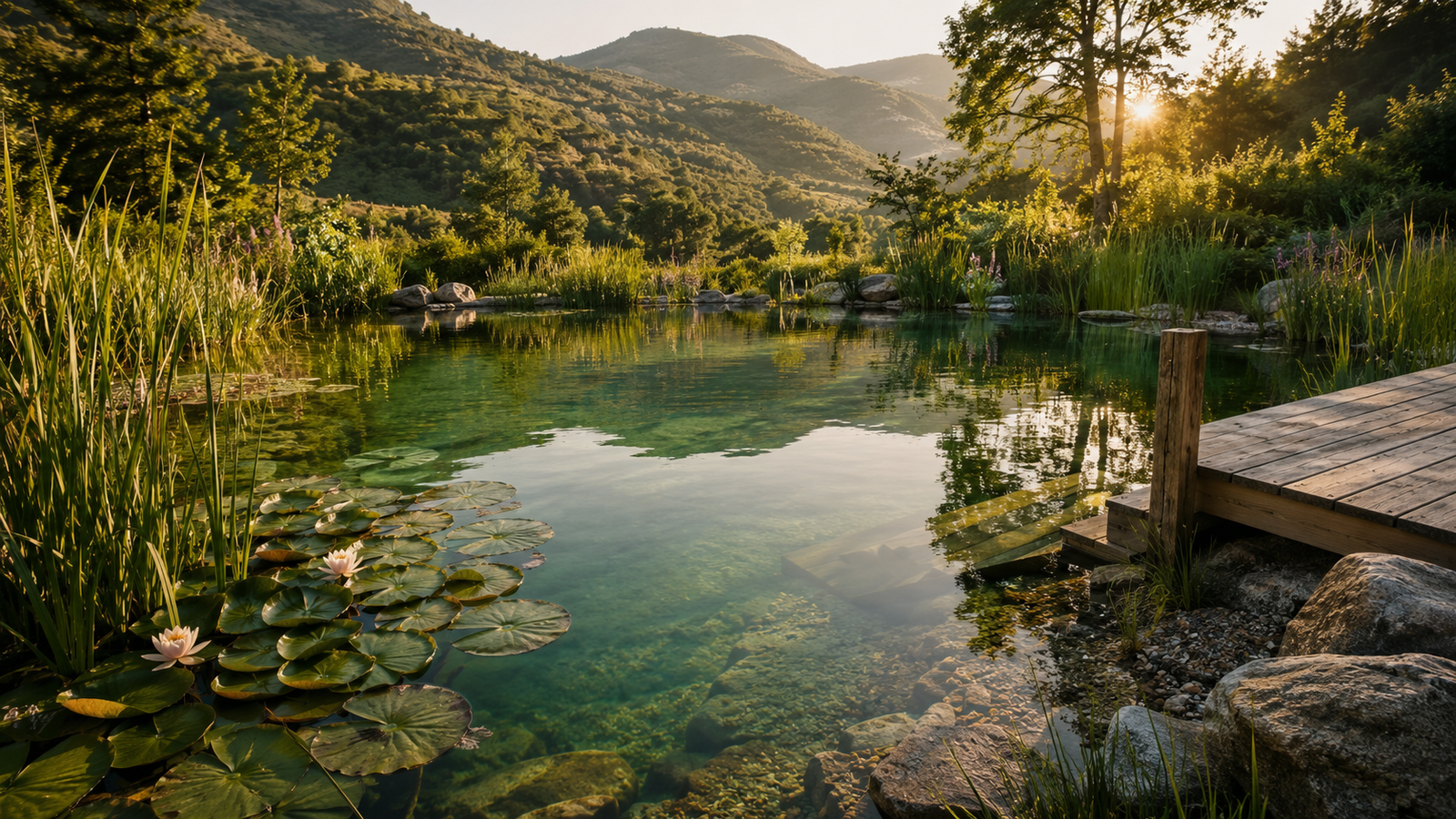
The biological swimming pond — called a piscine naturelle in French, a Naturpool in German, and increasingly just a *piscina biológica* in Portuguese — is one of the most appealing elements of any ecological retreat. It is also the element most frequently misunderstood, undercosted, and built too early.
We are building one at Lusitano. Not in Phase 1. Here is what it involves, what it costs, and why the sequencing matters.
A biological swim pond works through a simple principle: a dedicated plant filter zone treats the water biologically before it circulates back to the swimming area. There are no chemicals. There is no chlorine, no bromine, no pH balancing with industrial reagents. The water is maintained by the same processes that keep a healthy lake clean: aquatic plants taking up nutrients, beneficial bacteria breaking down organic matter, marginal plants filtering fine particles at the edges.
The design consists of two zones separated by a low underwater wall or barrier. The swimming zone is the deeper area — typically 1.5–2 metres — where guests actually swim. It has a clean sand or gravel bottom and no planted vegetation. Adjacent to it, occupying at least 50% of the total water surface area (ideally 60–70%), is the regeneration zone: a shallower area, 40–80 cm deep, densely planted with aquatic and marginal plants. Water is pumped slowly from the swimming zone through the regeneration zone and back, completing a continuous biological filtration circuit.
The plant selection for the regeneration zone is critical. The core plants for North Portugal's climate are common reed (*Phragmites australis*), yellow iris (*Iris pseudacorus*), reed mace (*Typha latifolia*), watercress (*Nasturtium officinale*), and water mint (*Mentha aquatica*). These are not chosen for aesthetics, though they are visually striking — they are chosen for nutrient uptake capacity and biological filtration efficiency. The watercress and water mint also have a secondary function: they are edible, and both grow in conditions that make them available for the kitchen nine months of the year.
The pump system runs continuously at low flow — not filtering mechanically, but ensuring water circulation prevents stagnation. A simple submersible pump of 300–500 watts is sufficient for a pond up to 80 m². Solar-powered pump systems are viable if the solar array is correctly sized for the run hours and head pressure. There is no UV filtration required, no sand filter, no automatic dosing system. The operating cost is electricity for the pump: roughly €30–50 per month.
Construction cost in Portugal depends primarily on scale, liner specification, and whether you excavate by machine or by hand. For a pond providing a usable swimming area of 30–40 m² (total water surface 80–100 m² including the regeneration zone), the realistic cost range is €15,000–€30,000. This breaks down approximately as: excavation (€2,000–€4,000 by machine), EPDM liner (€3,000–€6,000 depending on quality), structural edging and underwater wall (€2,000–€4,000), pump and plumbing (€800–€1,500), plant stock and substrate (€1,500–€3,000), landscaping and finishing (€3,000–€8,000). A larger or more finished pond — 50 m² swimming zone with professional natural stone edging — can reach €40,000 or above.
The maintenance reality is that a well-planted biological pond is genuinely low-maintenance compared to a conventional pool, but not zero-maintenance. In spring, marginal plants are cut back before new growth emerges — this removes the nutrient-loaded dead plant material from the system and is the single most important maintenance action of the year. In summer, water levels may need topping up during dry periods. Algae: every natural pond has some. The quantity and type depend on plant density and nutrient load. A dense, well-established regeneration zone keeps algae minimal. A sparse, newly planted one has more. Years 1 and 2 are the hardest years for water clarity — as planting matures, the biology stabilises.
The legal situation in Portugal for biological swim ponds is, as of early 2026, not specifically regulated. There is no dedicated permitting pathway for natural swimming ponds in the way that there is for conventional pool construction. In practice, for a privately operated rural retreat, a biological pond is typically treated as a decorative water feature with a sanitation function and does not require a specific licence. However, if the retreat is licensed as TER (Turismo em Espaço Rural), the guest facilities must meet Turismo de Portugal health and safety standards — which may require documentation that the pond water meets bathing water quality standards. Environmental authorities (APA) may require a licence for water extraction if the pond is fed from a watercourse.
We are not building the swim pond in Phase 1. The reasons are straightforward: it is not revenue-generating on its own; it requires ecological establishment time (2–3 seasons for the plant filter to mature); and it represents €15,000–€30,000 of capital that, in Phase 1, is better deployed in accommodation that starts generating income from the first booking. The pond is Phase 2: once the first two accommodation units are operational, revenue-positive, and the retreat's ecological systems are established, the pond becomes the next major investment.
We document the design in detail now because the excavation and liner work should happen before the landscape is fully planted. Machinery access for a future pond needs to be preserved in the site plan from day one — even if the pond itself is years away. This is the kind of forward sequencing that is invisible when you are in it and very expensive when you have to retrofit it.
The swim pond is the reason people describe Lusitano Retreat in the third or fourth sentence when they tell someone about it. It is not the first thing we are building. It is the reason we are thinking clearly about what the first things are.