Six-thirty. The chickens know it is morning before you do.
There is no alarm. No schedule. No reason to rush. The light comes in low through the timber walls — rough-sawn larch, cut thick, the grain still visible where the saw touched it. The smell is wood and damp stone and something faintly herbal from the path outside. You are in North Portugal, an hour from Porto, and absolutely nothing is asking you to be anywhere.
This is what we are building at Lusitano Retreat. Not a set of units. Not an occupancy rate. A morning like this one.
The orchard is the first thing worth walking into. In August, the fig tree at the entrance has two crops going at once — the early breba figs from last spring's growth and the main summer flush coming in now, fat and splitting at the base. You pull one open. The colour inside is deep burgundy. You eat it standing there, in the path, and do not feel the need to document it.
Further in, the mulberry is the extravagant one. One mature mulberry in the Minho gives three hundred kilograms of fruit in a season. Most of it falls. Most of it goes to the ground, the chickens, the birds. There is always too much. This is, in fact, the point. A retreat that has too much — too much fruit, too much firewood, too much silence — is doing something the hotel industry has entirely forgotten how to do.
By seven o'clock, there are eggs. The chicken tractor has moved onto the far corner of the vegetable beds, and the flock has done their morning's work: scratched, eaten, fertilised, moved on. The eggs are warm and not yet clean. You collect four of them in a borrowed basket and bring them back to the cabin. Breakfast from the property is not a marketing claim here. It is just what happens before eight AM.
The kitchen garden runs in three long no-dig beds along the southern edge of the plot. This time of year the tomatoes are the drama — heavy clusters of a local variety that splits when it rains and smells of nothing like a supermarket tomato. Beside them, courgette plants with stems the width of your wrist, producing at a rate that requires giving vegetables to neighbours. Kale that has been here since October and is still standing. Garlic plaited and hanging from the ceiling inside the main barn.
The retreat does not feed itself. It is not trying to. A small kitchen garden and a handful of fruit trees are not a food system. They are an invitation. They say: something grows here. This place is alive. Come and take what is ready.
By nine, the pond has morning light on it. Not the swim pond — that comes later, in Year 2, when the accommodation is established and the ecological systems have had time to mature. For now there is the fishing pond: three hundred square metres of still water, carp moving slow below the surface, reed at the margins catching wind. The fishing rods lean against the willow. Guests use them or they don't. There is no instruction.
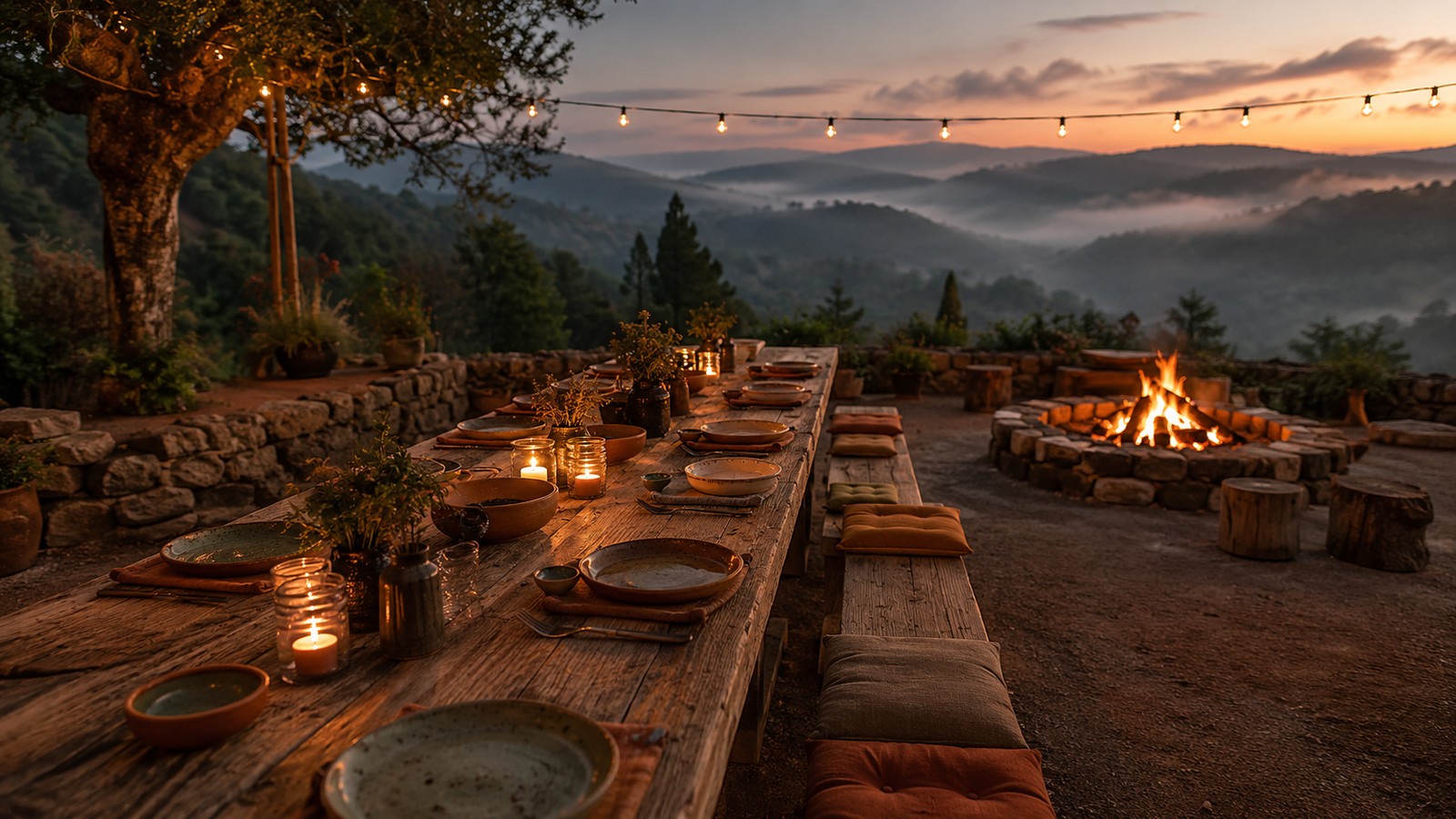
The fire pit is the evening, not the morning. But it earns its place in this account because it is what most guests describe when they explain why they came back. Something about sitting outside after dark, near fire, without the need for music or conversation, in a country that smells different from home. It is the simplest thing on the whole property. It cost three hundred euros. It is irreplaceable.
We are not open yet. The land is not yet purchased. The caravans are not yet clad in timber. The orchard has not been planted. The fishing pond is a drawing on a plan.
But this morning exists in the logic of what we are building. Every decision made — about materials, about sequencing, about what to build first and what to leave for later — is tested against it. Does this choice make that morning more possible, or less?
That is the only question we are answering right now.
Follow the journal. We are writing the honest version of how this gets built.