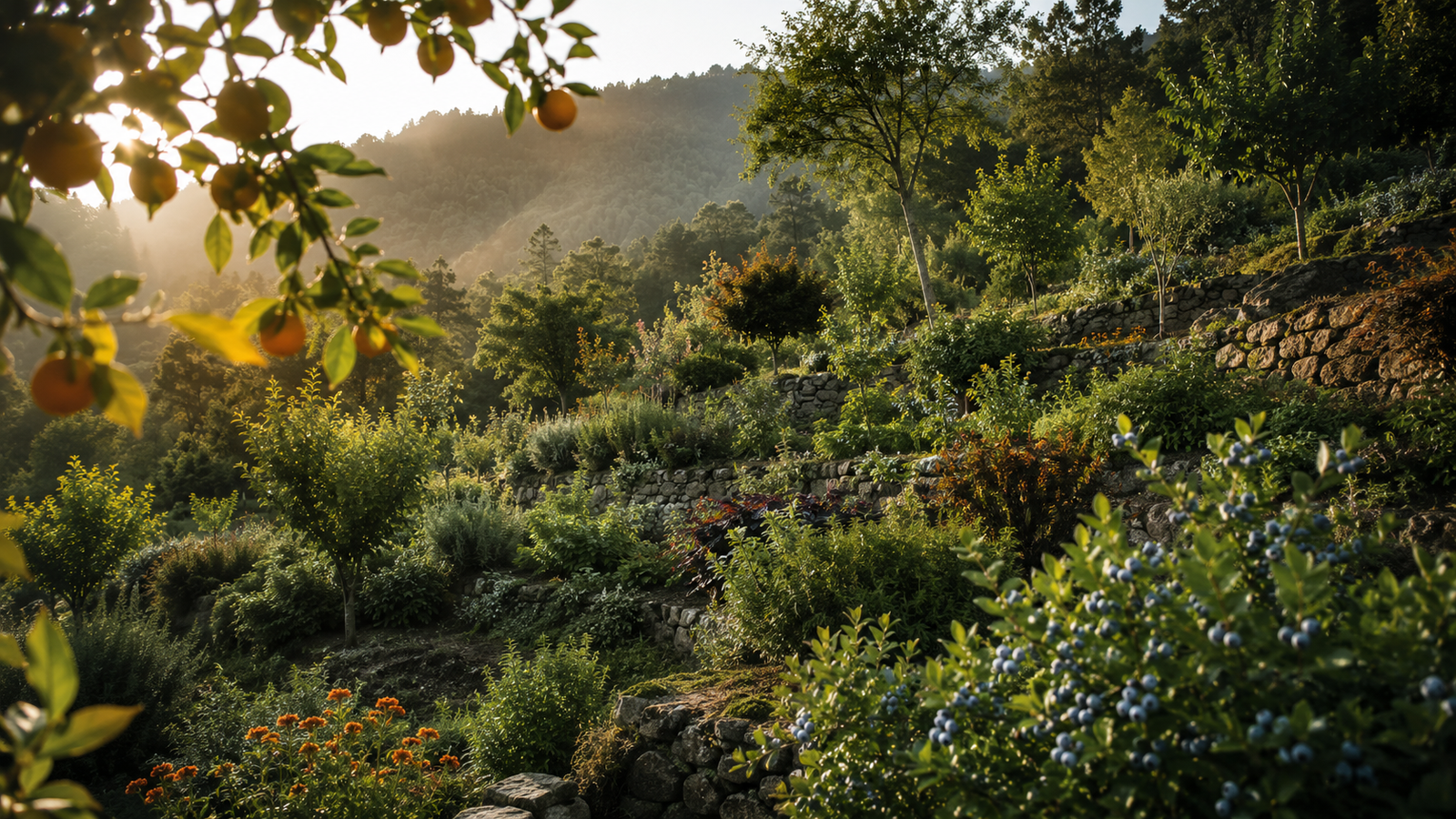
The most important design decision we have made about the Lusitano Retreat is not about the accommodation units. It is not about the pond or the solar system or the septic. It is the decision to plant the food forest in Year 1 — before the first unit is built, before the first guest arrives, possibly before the land is even fully purchased.
The reason is simple: trees take time. A mulberry planted this autumn will fruit in three years. A walnut planted now will be producing properly in a decade. A fig takes two seasons to establish and then gives 20 kilograms of fruit per tree, twice a year, for the next fifty years. Every year spent not planting is a year of production lost permanently. You cannot compress it later.
The food forest model — sometimes called a forest garden or *floresta de alimentos* — structures an edible landscape in overlapping vertical layers that mimic the structure of a natural forest. It is not a vegetable garden. It is not an orchard. It is a designed ecosystem in which every layer serves multiple functions simultaneously: food production, habitat, soil building, water retention, shade, windbreak, and — not incidentally — the kind of beauty that makes guests stop walking and just look.
The first layer is the canopy: the tallest trees that define the upper structure. For the Minho climate, the two most important canopy trees are the mulberry and the walnut. The mulberry (*Morus nigra* or *M. alba*) is extraordinary in this region — it grows fast, fruits abundantly within 3–5 years from planting, and produces at a scale that feels almost absurd. A single mature tree yields 200–500 kilograms of fruit per season, most of which falls to the ground and feeds everything below it. The walnut (*Juglans regia*) is slower — 8–12 years to meaningful production — but it is permanent infrastructure. You plant it once and it becomes the backbone of the landscape for a century. Add the sweet chestnut (*Castanea sativa*), native to the Minho hills and a cultural touchstone: autumn chestnut roasting is one of the most Portuguese things a retreat can offer.
The sub-canopy layer sits beneath the canopy trees: smaller fruit trees in the 3–6 metre range. For North Portugal, this means apple and pear in traditional local varieties — not commercial cultivars, which were bred for supermarket shelf-life and sacrifice flavour and resilience. Ask at the local market or agricultural cooperative for the names that have been grown in the valley for generations. Fig (*Ficus carica*) is essential: two crops per year in the Atlantic climate, virtually no maintenance once established, fruit that guests eat standing in the path without thinking. Persimmon (*Diospyros kaki*) extends the productive season into October and November — the low season for the retreat — with fruit that hangs on bare branches like orange lanterns and produces 30–60 kilograms per tree at maturity.
The shrub layer is where the elderberry belongs. *Sambucus nigra* grows to three metres in two years in the Minho climate. The flowers in June are the basis for the best welcome drink a retreat can offer: elderflower cordial, made on-site from flowers picked that morning. The berries in August and September become jam, syrup, and wine. It is also an important habitat plant — pollinators use it heavily. Blackcurrant and redcurrant fruit from Year 2. Rosemary, lavender, and sage provide year-round structure, fragrance on the path, and an inexhaustible kitchen supply.
The climbing layer uses fences, pergolas, and the edges of existing structures. Kiwi (*Actinidia deliciosa*, hardy varieties) climbs on horizontal wire and produces 30–50 kilograms per plant from Year 3 or 4. Grape is culturally inevitable in the Minho — this is the Vinho Verde region — and even a single row of 10–15 plants alongside a path creates an atmosphere that no designed feature can replicate. The act of picking a grape and eating it in late August while a guest, in their own garden, is one of those small moments that ends up in the review.
The herbaceous layer is the lowest perennial layer: plants that die back in winter and return from the root. Comfrey (*Symphytum officinale*) is the foundational plant of this layer — its deep taproot mines minerals from the subsoil that shallower roots cannot reach, and its leaves, when cut and left as mulch, decompose rapidly and feed everything around them. Jerusalem artichoke (*Helianthus tuberosus*) is productive beyond any reasonable expectation: 3–6 kilograms per square metre of edible tubers, every autumn, from a plant that propagates itself without any assistance and laughs at drought, cold, and neglect.
The ground cover layer — low-growing plants that suppress weeds and protect soil — includes strawberries (Year 1 fruiting, essentially free), creeping thyme (fragrant path edging that handles foot traffic), and wild garlic (*Allium ursinum*) where there is shade and moisture. The root layer is the unseen lower layer: garlic planted in October, harvested in June; tubers like topinambur and potato establishing themselves between the longer-lived plants above.
The no-dig vegetable beds sit alongside the food forest rather than within it. On 100 m² of sheet-mulched beds — cardboard laid directly on existing grass, topped with 20 cm of compost, planted immediately — a solo operator can grow enough leafy greens, herbs, tomatoes, and courgettes to supply a retreat's kitchen continuously. In the Minho, the Atlantic climate means year-round production is genuinely possible: kale and chard through winter, tomatoes and peppers through summer, with almost no gap in the calendar.
The cost of this entire system — canopy trees, sub-canopy, shrubs, climbers, herbaceous layer, ground cover, no-dig beds — for a small rural property is between €500 and €1,200 for the first planting season. That is the cost of one night in a premium hotel, spent once, producing food and beauty for the next 50 years.
We are planting before the accommodation is built. The orchard will be three years old when the first guest arrives. The fig will already know where it is. The mulberry will be learning the scale of what it is going to become.
This is the only correct order of operations.