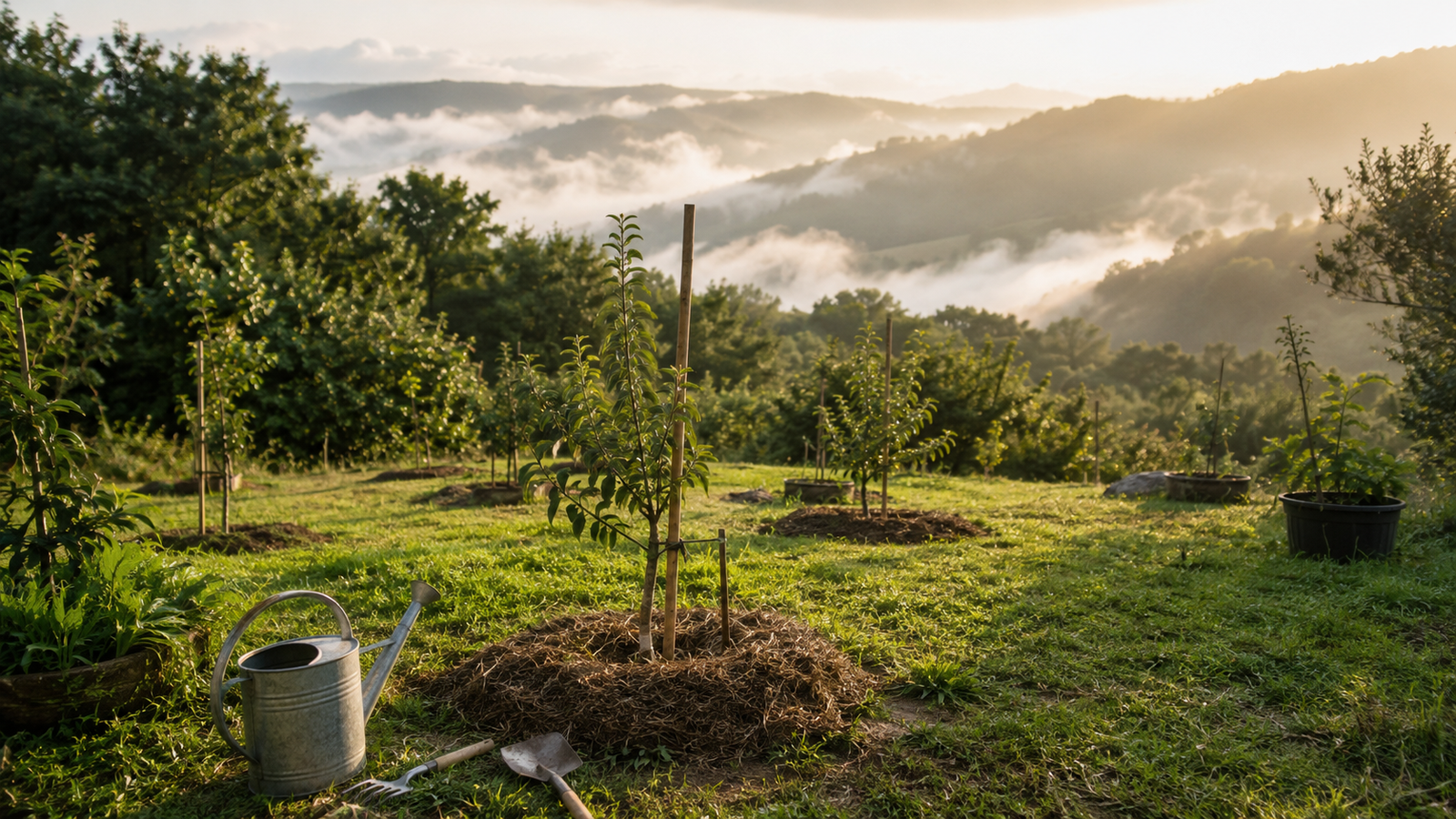
We made a lot of mistakes in Year One. We also did some things exactly right. This is the honest account of both.
A food forest is a multi-layered perennial planting system designed to mimic the structure of a natural woodland while producing food, medicine, and habitat. In practice, it means planting things at seven different vertical layers — from canopy trees down to underground root crops — and then mostly stepping back to let them grow.
The theory is elegant. The practice, on rocky granite hillside in northern Portugal in November, is something else entirely.
## What We Planted (and What Survived)
**Canopy layer (4 trees planted, 4 survived):** Sweet chestnut (Castanea sativa) is indestructible here. This is its native territory. All four trees went in, all four are thriving. We added one walnut (Juglans regia) and two wild service trees (Sorbus torminalis). Everything in the canopy layer was planted as bare root in November — the cheapest and most effective way to establish trees.
**Sub-canopy layer (12 trees planted, 9 survived):** Fig (4), quince (3), plum (3), pear (2). We lost one quince to waterlogging — we hadn't mapped the drainage properly — and two plums to what we suspect was a fungal issue in the unusually wet first winter.
**Shrub layer (18 plants planted, 16 survived):** Elder (Sambucus nigra) went in everywhere as a pioneer species. Two gooseberries. Hawthorn along the southern boundary as windbreak. Rosemary on south-facing slopes.
**Groundcover (fully established by month 8):** Comfrey (Symphytum officinale) was our best decision. We planted 40 root cuttings in March and by July had a dense groundcover that suppressed weeds, attracted pollinators, and provided unlimited chop-and-drop mulch material. Yarrow and clover filled in around the trees.
## The Mistakes
**Mistake 1: We didn't sheet mulch first.** Every article and book tells you to sheet mulch before planting. Cardboard, then wood chips, then plant through holes. We planted into rough-cut grass and spent six months hand-weeding around young trees. Never again.
**Mistake 2: We planted in the wrong season for some species.** The fig and quince should have gone in earlier, in October, not December. The late planting meant they missed the best root establishment window before the dry spring hit.
**Mistake 3: We underestimated rabbit pressure.** North Portugal has an enormous rabbit population. We lost several young shrubs before we installed tree guards. This sounds basic. It cost us several hundred euros in replacement plants.
## What We Got Right
**Buying bare-root local stock.** Our nursery contact in Montalegre had everything we needed at €3–8 per tree. Named varieties, healthy stock, properly dormant. Don't buy pot-grown trees from garden centres for large-scale planting — the cost differential is enormous and bare-root establishment is as good or better if planted correctly.
**Planting water harvesting swales before the trees.** We ran a one-day earthworks session in October with a mini-digger to create three simple on-contour swales on the slope above the main food forest area. The trees planted in the swale berm line established visibly faster and needed zero supplementary irrigation in their first summer.
**Starting small.** Our Year One food forest covers 0.3 hectares. That's the right scale to manage carefully, make mistakes in, and learn from. The temptation is always to do more. Resist it.
## Year Two Plan
Year Two is about filling the gaps, extending the groundcover, adding more comfrey, and beginning to introduce the vine layer (kiwi, grape). We're also starting a dedicated annual kitchen garden adjacent to the food forest so we can integrate the two systems over time.
The food forest won't be genuinely productive for another 4–6 years. That's fine. We planted it on day one so it's already 12 months closer than if we'd waited.
---
*Interested in joining one of our planting days? We run seasonal volunteer sessions. Get in touch.*